
What If Your Chaos Is the Stage for God’s Glory?
Your storm is not proof that God is absent. It may be the very place His glory is about to be seen.
By Reuben Chief Guma · 8 min read
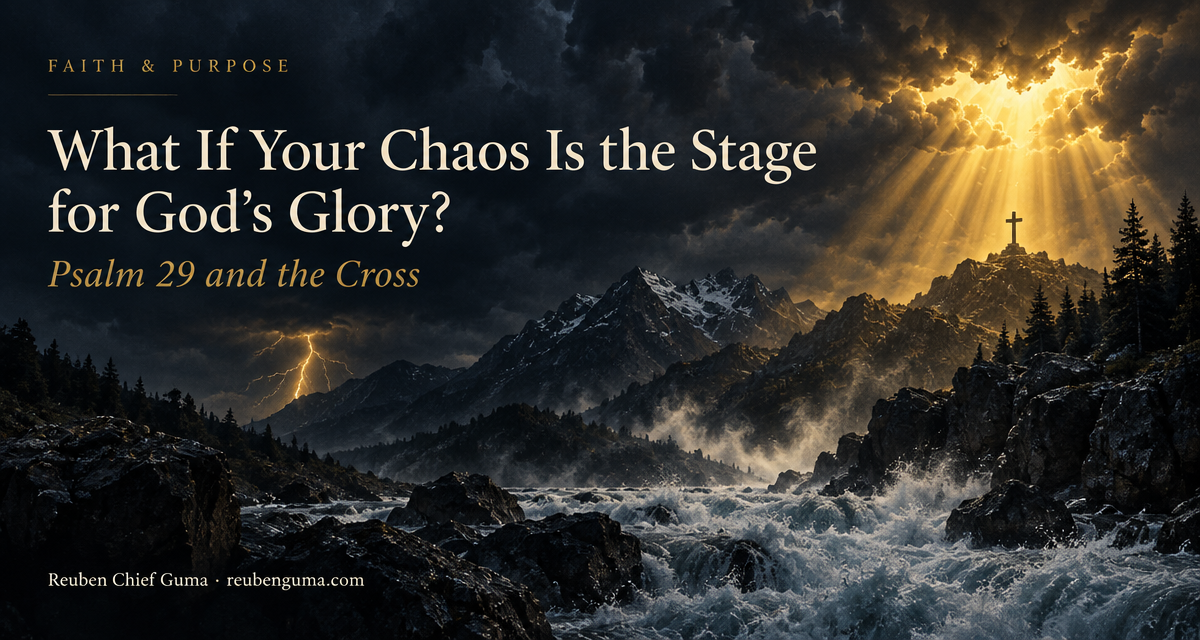
The diagnosis came on a Tuesday. Or the redundancy letter. Or the phone call you still replay at 3 a.m. Whatever your storm looks like, it probably arrived without asking permission, and it brought a question with it: if God is real and good, where is He in all of this?
Most of us quietly assume that chaos is evidence of God’s absence. Calm seasons feel like blessing; turbulent ones feel like abandonment. But Scripture tells a very different story. Again and again, the place of upheaval becomes the place where God’s glory is most clearly seen.
What if your chaos is not the end of the story, but the stage?
A Psalm Written in a Thunderstorm
Psalm 29 is one of the most dramatic songs in the Bible. David pictures a storm rolling in from the Mediterranean, crashing over the mountains of Lebanon and sweeping down into the wilderness of Kadesh. Seven times he repeats the phrase “the voice of the LORD.” It thunders over the waters. It breaks the cedars. It strikes with flashes of lightning. It shakes the desert and strips the forests bare.
This is not a gentle meditation by a quiet stream. It is worship shouted over the noise of a storm. And right in the middle of it comes this line:
“And in his temple all cry, ‘Glory!’” (Psalm 29:9, NIV)
Notice where the worshippers are, and when they cry out. They do not wait for the storm to pass. They see the same lightning everyone else sees, hear the same thunder, feel the same ground shake, and they recognise something others miss: God is in this, and He is glorious.
God Is Enthroned Over the Flood, Not Absent From It
The meaning of Psalm 29 turns on verse 10: “The LORD sits enthroned over the flood; the LORD is enthroned as King for ever.” In the ancient world, the flood was the ultimate symbol of chaos, the untamed force that undid order and swallowed life. David does not say God removed the flood. He says God is seated above it, ruling.
That is a very different kind of comfort. It does not promise you a life without storms. It promises that no storm is bigger than the throne. The waters may be high, but they are under Someone.
Then the psalm ends with a promise for ordinary people caught in the weather: “The LORD gives strength to his people; the LORD blesses his people with peace” (verse 11). Strength and peace are given in the storm, not only after it.
Finding God in the Wilderness
David mentions the wilderness of Kadesh by name. That detail matters. Kadesh was where Israel wandered, doubted and grumbled. It was a place associated with failure and delay. Yet the psalm says the voice of the LORD shakes even there.
The wilderness is never outside God’s reach. Hagar met “the God who sees me” in the desert (Genesis 16:13). Moses heard his calling from a burning bush on the far side of the wilderness (Exodus 3). Elijah, exhausted and ready to die, heard a gentle whisper on a mountain after the wind, the earthquake and the fire (1 Kings 19:11–13). Jesus Himself was led into the wilderness and came out in the power of the Spirit (Luke 4:1–14).
If you are finding God in the storm hard right now, take heart: the barren places have a long history of becoming holy ground.
The Darkest Stage of All
The clearest picture of glory in chaos is not a thunderstorm. It is a cross.
When Jesus was crucified, everything looked like disorder. Friends scattered. Soldiers mocked. The sky went dark at midday and the earth shook (Matthew 27:45, 51). To every observer it looked like the triumph of chaos over goodness.
And yet Jesus had already said, “The hour has come for the Son of Man to be glorified” (John 12:23). He was speaking of the cross. The moment that looked like total defeat was the moment God’s glory shone brightest, because it was the moment His love was most fully displayed.
“When he had received the drink, Jesus said, ‘It is finished.’ With that, he bowed his head and gave up his spirit.” (John 19:30, NIV)
“It is finished” was not the sigh of a victim. It was the declaration of a victor. In the middle of darkness, earthquake and grief, the work of redemption was completed. Three days later, the empty tomb proved it.
This changes how we read our own storms. If God could turn the worst day in history into the doorway of salvation, He is not intimidated by yours. Because the decisive battle is already won, your chaos is not the final word. The finished work of Jesus is.
Why We Struggle to Worship in Crisis
Honestly, worship in crisis feels unnatural. Pain narrows our vision. We fix on the waves, the bills, the test results, the silence. Praise can feel dishonest, as if we are pretending everything is fine.
But biblical worship is not pretending. It is perspective. The Psalms are full of lament: people crying, questioning and complaining to God. Worship does not deny the storm. It refuses to let the storm have the last word about who God is.
Paul and Silas sang hymns at midnight in a prison cell with their backs bleeding (Acts 16:25). Job, having lost almost everything, fell to the ground and worshipped (Job 1:20–21). Their faith in hard times was not the absence of pain. It was a decision about where to look.
Five Practices for Worshipping in Chaos
Here are five simple practices drawn from Psalm 29 and the cross. They will not make the storm disappear, but they will help you see God’s glory in it.
Name the storm honestly. Tell God exactly what is happening and how you feel. Lament is worship too. You cannot invite God into a storm you refuse to admit is raging.
Listen for His voice above the noise. Psalm 29 repeats “the voice of the LORD” seven times. Each day, read a short passage of Scripture before you read the news or your messages. Let His voice be the loudest one.
Look up to the throne. When panic rises, pray verse 10 aloud: “The LORD sits enthroned over the flood.” You are reminding your own soul who is in charge.
Anchor yourself at the cross. When you wonder whether God cares, return to John 19:30. The One who finished your salvation will not abandon you halfway through your storm.
Say “Glory” before you see the outcome. Choose one moment each day to thank God for something specific, even something small. Gratitude in the middle of chaos is a declaration of faith.
Key idea: The storm reveals what was always true. God is enthroned, Christ has finished the work, and His glory is not cancelled by your chaos.
A Word to Leaders
If you lead a family, a team or a church, people are watching how you handle the storm. You do not need to look unshaken. You need to show them where you stand. Leaders who worship in crisis give others permission to do the same, and that is often where God’s glory is first seen: in the steady faith of someone who is clearly hurting, yet still trusting.
If your season has become overwhelming, please also reach out to a trusted friend, pastor, doctor or counsellor. Asking for help is not a lack of faith. It is one of the ways God carries us through.
Reflect
What storm am I treating as proof that God is absent?
Where might God be shaking a “wilderness” in my life to make it holy ground?
What would change if I truly believed God is enthroned over my flood?
Which of the five practices could I begin today?
Closing Charge
Your chaos is real. But it is not ultimate. The same God whose voice breaks the cedars sits enthroned over every flood, and the same Saviour who cried “It is finished” in the darkness is with you in yours.
So do not wait for the weather to clear before you worship. Lift your eyes, name the storm, and say it with the worshippers in the temple: Glory. One day you may look back and see that this was the very stage on which God showed you who He is.
A short prayer
Lord, the storm is loud and I am tired. Yet You are enthroned over the flood. Thank You that on the cross You finished the work I could never finish, and that nothing I face is bigger than Your throne. Speak above the noise. Give me Your strength and Your peace, and open my eyes to see Your glory here. Amen.
If this season has you asking what comes next, read the free chapter of my book Your Next Is Now. Remember: Your Next Is Now.
Share this
Pass it to someone who needs it
Keep reading
Go deeper into the strength God gives in the storm.